
Recovery Isn't Linear, and That's Okay
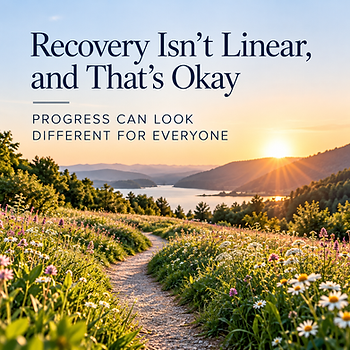
Progress can look different for everyone, and a difficult day doesn't erase how far you've come.
When we imagine recovery, we often picture a journey that moves steadily forward.
We imagine taking the first step, making changes, feeling better, and eventually reaching a place where everything becomes easier.
A straight line from struggling to healing.
But for many people navigating eating disorders, disordered eating, or body image concerns, recovery doesn't look quite like that.
Some days, you might feel hopeful and motivated.
You may notice yourself questioning old beliefs, challenging familiar patterns, or feeling more comfortable with uncertainty.
Other days, those same thoughts and behaviours might feel overwhelming again.
You might question your progress.
Wonder whether you're doing enough.
Or feel discouraged because something you thought you had moved past suddenly feels difficult again.
And when that happens, it's easy to believe you've somehow failed.
But here's something important to remember:
A difficult day does not automatically mean you've lost the progress you've made.
Recovery is a process, and that process is rarely as straightforward as we expect.
Why We Expect Progress to Be a Straight Line
We live in a world that often measures success through visible results.
We set goals, create timelines, track achievements, and celebrate reaching the next milestone.
In many areas of life, we're taught that progress means constantly moving forward.
And when things don't go according to plan, we may interpret that as a setback or failure.
But emotional and behavioural change is often more complicated.
Our experiences are influenced by stress, relationships, physical health, environments, emotions, and the challenges we encounter throughout life.
Something that felt manageable last week might feel more difficult today.
A situation that once triggered anxiety might become easier to navigate, while a completely different experience brings up unexpected feelings.
That doesn't mean the work you've done has disappeared.
It means you're human.
Progress isn't always about never struggling again. Sometimes, it's about developing new ways to recognize, understand, and respond to those struggles.
When Old Thoughts Resurface
One of the discouraging parts of recovery can be the return of thoughts you hoped you'd left behind.
Perhaps you've been working on developing a more flexible relationship with food, but suddenly notice familiar feelings of guilt after eating.
Maybe you've become more comfortable taking rest days, only to experience anxiety when your exercise routine changes.
Or perhaps you've been feeling more accepting of your body, but a photograph, comment, or difficult day brings up old insecurities.
These experiences can feel frustrating.
You might find yourself thinking:
I thought I was past this.
Why am I still struggling?
Shouldn't this be easier by now?
But the presence of a difficult thought doesn't necessarily mean you've returned to where you started.
There can be a meaningful difference between having a thought and responding to it in the same way you once did.
You might notice the thought sooner.
Recognize that it reflects an old pattern.
Talk about it with someone you trust.
Or use a strategy developed with your treatment team rather than automatically acting on the urge.
Those responses matter.
At the same time, if eating disorder behaviours are returning or becoming more frequent, it's important to take them seriously and seek timely support. Reassurance about the recovery process should never replace assessment of a possible relapse or medical risk.
The Difference Between a Difficult Day and Losing Progress
Imagine you're learning a new skill.
Some days, everything seems to come naturally.
Other days, you feel distracted, frustrated, or unable to perform the way you usually do.
You wouldn't necessarily conclude that everything you've learned has disappeared.
You might recognize that learning involves practice, repetition, and adjusting to new situations.
Recovery can involve a similar process of learning, although eating disorders are serious health conditions rather than simply habits to overcome.
You may be learning how to recognize unhelpful beliefs.
How to communicate your needs.
How to respond to uncomfortable emotions.
How to challenge rigid expectations.
Or how to build a sense of identity that isn't entirely connected to food, exercise, or appearance.
These changes can take time.
And they don't always become easier in a predictable order.
Having a difficult moment doesn't erase the understanding, awareness, or skills you've developed along the way.
What matters is noticing what is happening and responding with appropriate care, rather than assuming that one difficult experience defines your entire journey.
When Comparison Makes Recovery Feel Harder
Sometimes, the pressure we place on ourselves comes from comparing our experiences to someone else's.
Perhaps you've read about someone who describes reaching a particular milestone.
Maybe you've seen a social media post celebrating a recovery anniversary.
Or perhaps someone you know appears to be moving forward more quickly than you are.
It's natural to wonder why your own journey looks different.
But recovery isn't a competition.
People have different histories, circumstances, support systems, health needs, and experiences.
What feels challenging for one person may be different for another.
And what works for someone else may not be appropriate for you.
Even the milestones people share publicly rarely tell the whole story.
We don't always see the uncertainty, difficult conversations, treatment adjustments, or quieter moments that happen behind the scenes.
Someone else's progress does not determine the value of your own.
Your journey deserves to be understood within the context of your life, not measured against someone else's timeline.
Progress Can Look Different Than You Expected
When people think about recovery, they sometimes focus on major milestones.
And those milestones can absolutely be meaningful.
But progress may also involve changes that are less visible.
It might look like:
Recognizing a food-related thought without immediately judging yourself.
Being more honest with your treatment team about something you're finding difficult.
Asking for support rather than keeping your concerns to yourself.
Beginning to question a belief you've held for years.
Identifying situations that increase your anxiety.
Recognizing that your worth extends beyond your body or performance.
Becoming more open to receiving help, even when doing so feels uncomfortable.
Not every one of these experiences will apply to everyone, and they aren't substitutes for medical or nutritional recovery when those are needed.
But they can represent meaningful changes in how someone understands and relates to their experiences.
Sometimes, growth happens in ways that are difficult to measure.
And sometimes, recognizing those changes requires us to look beyond the expectations we initially created for ourselves.
What Can We Learn From Difficult Moments?
When something feels challenging, our first instinct may be to criticize ourselves.
We might focus on what went wrong.
What we should have done differently.
Or why we weren't able to respond the way we hoped.
But self-criticism doesn't always help us understand what happened.
Instead, it may be useful to approach the experience with curiosity.
What was happening in my life when things became more difficult?
Was I experiencing additional stress?
Did something bring up an old fear or belief?
Was I feeling unsupported, overwhelmed, or disconnected?
What support might I need now?
These questions aren't about blaming yourself or finding a perfect explanation.
They're about recognizing that difficult moments can provide useful information.
Sometimes, they highlight an unmet need.
Sometimes, they reveal a situation that requires additional support.
And sometimes, they remind us that the strategies we've been using may need to be adjusted.
A difficult experience can be something to learn from without becoming something to punish yourself for.
Recovery Doesn't Mean You Have to Do Everything Alone
One misconception about recovery is that progress should eventually mean no longer needing help.
We may imagine that asking for support means we're not doing well enough on our own.
But reaching out doesn't diminish your progress.
In fact, recognizing when you need additional care can be an important part of taking your well-being seriously.
Recovery may involve support from physicians, therapists, registered dietitians, family members, friends, and other appropriate professionals.
The type and level of care someone needs can change over time.
Some individuals may require more intensive treatment at certain points, while others may benefit from ongoing support as they navigate everyday challenges.
Needing that support doesn't mean you've failed.
And if symptoms return or worsen, reconnecting with qualified healthcare professionals promptly is important. Eating disorders can affect physical health at any body size, even when outward signs are not obvious.
You don't have to prove your strength by navigating every difficult moment alone.
Giving Yourself Permission to Be Human
One of the challenges of recovery can be learning to respond to yourself differently.
Especially if you've spent years holding yourself to rigid expectations.
You may be accustomed to believing that mistakes are unacceptable.
That progress should happen quickly.
Or that struggling means you aren't trying hard enough.
But meaningful change often involves learning to make room for uncertainty, discomfort, and imperfection.
That doesn't mean ignoring harmful behaviours or avoiding accountability.
It means recognizing that accountability and compassion can exist together.
You can acknowledge that something needs attention without attacking yourself for experiencing it.
You can recognize a difficult pattern while still appreciating the effort you've made.
And you can take your recovery seriously without expecting yourself to navigate every moment perfectly.
You deserve compassion on the difficult days, not only the days when things feel easier.
Finding Your Own Meaning of Progress
At The Blue Bird Room, I believe that understanding someone's individual experiences is an important part of meaningful support.
No two people arrive with the same story.
And no two people will experience every part of their journey in exactly the same way.
Rather than assuming that progress must look a particular way, I believe in exploring what matters to the individual.
What are they hoping to experience differently?
What patterns have been affecting their well-being?
What fears or expectations may be making change difficult?
And what support could help them navigate the challenges they encounter?
My approach is collaborative, compassionate, and grounded in the belief that you are not someone who needs fixing.
You are someone whose experiences deserve to be understood.
Non-clinical recovery coaching may offer encouragement, education, and practical support when appropriate, including alongside a qualified eating disorder treatment team. It does not replace medical care, psychotherapy, or specialized eating disorder treatment.
A Final Thought
If your recovery hasn't followed the timeline you imagined, I hope you'll remember that your journey isn't defined by a single difficult day.
You don't have to compare your progress to someone else's.
You don't have to pretend that everything feels easy.
And you don't have to respond to every challenge perfectly.
You can acknowledge that something is difficult while still recognizing that your efforts and experiences matter.
You can ask for more support when you need it.
And you can continue exploring what recovery means for you, even when the path feels uncertain.
Recovery isn't always a straight line. But a winding path doesn't mean the journey has no direction.
You shouldn't have to reach a breaking point to deserve support.
Come as you are. Grow at your own pace.
Navigating the Ups and Downs of Recovery?
At The Blue Bird Room, you are welcome to explore your experiences with compassion, curiosity, and understanding.
Whether you're navigating eating disorder recovery, questioning your relationship with food or exercise, or working through body image concerns, you deserve appropriate support at every stage.
A complimentary 15-minute introductory conversation is planned to help you ask questions and explore whether non-clinical recovery coaching may be a suitable complement to your care.
You deserve to be understood, not judged. Supported, not pressured. And empowered, not defined by your struggles.


Comments